

GBB & GBBR Replica Specialist · Bordeaux
Published on [June 2015] · Updated on April 2026
Which airsoft gas should you choose? Technical guide to pressure (PSI) and temperature compatibility
Gas selection is the number one factor in the performance and longevity of a GBB replica. This technical guide, based on 24 years of workshop expertise at Univairsoft, helps you calibrate your pressure (PSI) according to the temperature and material of your cylinder.
Univairsoft Summary: Which gas to choose at a glance?
- Winter conditions (<10°C): Opt for a “High Pressure” gas of over 130 PSI.
- Spring / Fall (10°C - 25°C) : Choose a standard gas balanced between 110 and 130 PSI.
- Hot weather (>25°C): You must use low-pressure gas between 80 and 100 PSI.
- Japanese Replicas (Tokyo Marui): Maximum 110 PSI gas, otherwise the ABS receiver may crack.
- GBBR / Metal Receivers: Minimum 130 PSI recommended to ensure a complete cycle.
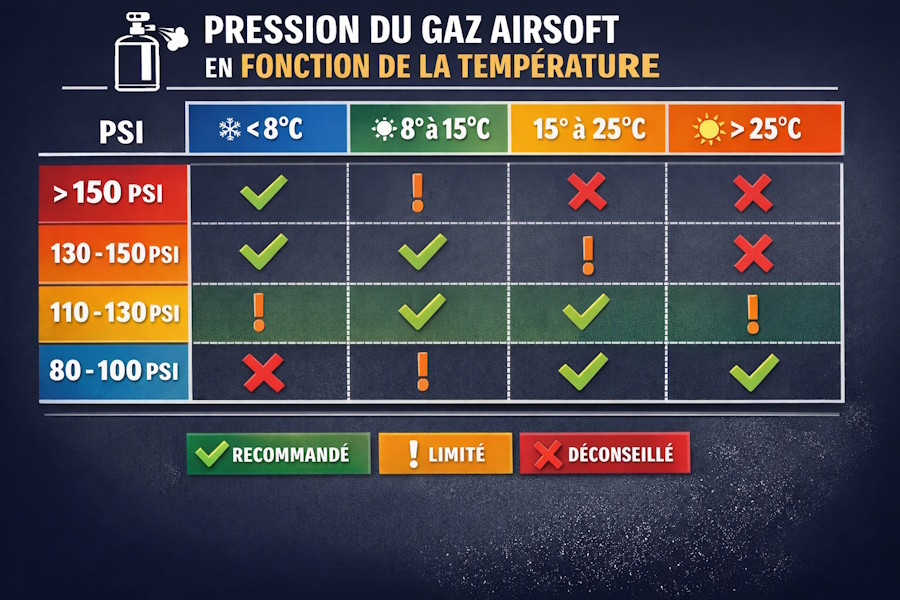
PSI / Temperature Chart: What pressure for what use and what material?
To help search engines index your data while guiding your purchases, here is the compatibility matrix used by our technicians:
| Pressure (PSI) | Ideal Temperature | Material Compatibility | Workshop Recommendation |
|---|---|---|---|
| 80 - 100 PSI | > 25°C (Summer) | ABS / Polymer (Marui) | Abbey 144a or Nuprol White |
| 110 - 130 PSI | 15°C to 25°C | Standard Metal / Reinforced ABS | Ultrair or Nuprol Green |
| 130 - 150 PSI | 8°C to 15°C | Full Metal / GBBR | Nuprol Red or Protech Gas |
| > 150 PSI | < 8°C (Winter) | Reinforced GBBR only | Nuprol Black or Nimrod Black |
Why does your GBB lose power in winter? The effect of temperature on gas pressure
A GBB replica operates on the principle of gas expansion. At low temperatures, the molecules contract, causing the pressure to drop. This explains the lack of recoil in winter.
Expertise from the Univairsoft workshop: In the field, we’ve observed that a GBB loses about 15 to 20 FPS for every 5°C drop in temperature if you don’t change the gas. To compensate for this without damaging the seals, check out our selection of high-pressure winter gas rather than straining the mechanics.
GBB cooldown: why your magazine empties suddenly and how to prevent it
Cooldown is the sudden drop in magazine temperature during rapid firing. When the liquid gas vaporizes, the endothermic reaction draws all the heat from the surrounding metal. In a matter of seconds, the wall of an aluminum magazine can drop from 20°C to less than 5°C. Result: the NBR seals shrink, the pressure drops, and you get the famous “psshhh” sound of complete degassing.
What our workshop measurements show:
| Magazine type | Consecutive shots before noticeable cooldown | Observed FPS drop | Recovery time (palm) |
|---|---|---|---|
| Thin aluminum (compact magazine) | 12 – 15 BBs | 20 – 35 FPS | 15 – 20 seconds |
| Thick aluminum (double-stack magazine) | 20 – 25 BBs | 15 – 25 FPS | 20 – 30 seconds |
| Stainless steel (GBBR magazine) | 25 – 35 BBs | 10 – 20 FPS | 25 – 35 seconds |
Data collected in the workshop at an ambient temperature of 18°C, using standard 110 PSI gas.
4 practical techniques to limit cooldown during play:
- Shoot in semi-auto or short bursts (3–5 BBs max) : Each fired BB cools the magazine. In semi-auto mode, you allow the metal to return to ambient temperature between each shot.
- Warm up the magazine between engagements: holding the magazine in your palm for 15 to 20 seconds is enough to restart vaporization and restore normal pressure. A technique used by all competitive players.
- Carry 2 to 3 magazines in rotation: while one is being fired, the others warm up in your pockets. This is the most effective method on the field.
- Use enriched propane-based gas: Propane has a lower boiling point than HFC134a, which improves vaporization at low temperatures and reduces the duration of the cooldown.
Univairsoft Field Tip: In winter (below 10°C), we recommend always starting out with preheated magazines in the inner pocket of your jacket—never in a cold backpack. The difference in the first 5 shots is immediate.
Silicone gas or dry gas for airsoft: what real impact do they have on your seals, hop-up, and accuracy?
This is a major debate within the community. Here is our recommendation based on the maintenance of replicas received for service at Univairsoft:
- Silicone Gas: Ideal for storage and casual players. It automatically keeps magazine seals airtight. Discover our lubricating silicone gases.
- Dry Gas: The choice of competitive players. It doesn't clog the hop-up seal, ensuring a much more consistent ball trajectory. Browse our range of competition dry gases. Note: Requires regular manual lubrication of the bolt.
What the Univairsoft workshop observes: 3 typical cases of damage caused by the wrong gas
Since 1999, our customer service department has handled several hundred GBB replicas per year. Here are three recurring failure patterns that we consistently associate with the wrong choice of gas. These case studies form the basis of our recommendations.
Replica received with a characteristic V-shaped crack at the rear of the polymer bolt. The player was using Nuprol Black (high-pressure winter gas) in the middle of August, at an ambient temperature of 28°C. At this temperature, the gas easily exceeds 170 PSI once inside the magazine, which has been heated by the sun. The ABS cylinder, designed to withstand a maximum of 120 PSI, fails at the ejector.
Diagnosis: misreading of the label. The player had purchased the “strongest gas” thinking it would improve performance in all seasons. The result was the opposite.
→ Workshop rule: Above 20°C, no gas exceeding 110 PSI on a polymer cylinder.
Replica stored for 3 months with magazine completely emptied, lubricated with motor oil (improvised substitute). Upon reactivation, the magazine empties in less than 2 seconds after being filled. Cause: the NBR seals in the valve kit were damaged by mineral oil, which is incompatible with this type of elastomer. Additionally, storing the magazine empty left the seals in constant contact with dry air, causing them to become porous.
Diagnosis: dual error — incompatible lubricant + dry storage. Either one alone might have been tolerated, but both together ruined the loader in a single summer.
→ Workshop rule: Always store with a layer of silicone oil. Never use mineral or vegetable oil on rubber parts.
The player alternated between Ultrair (dry gas) and a generic silicone-based gas in the same magazine without emptying it between uses. Shots exhibited abnormal dispersion of ±15 FPS between consecutive BBs and an irregular trajectory. After disassembly, the hop-up seal showed an uneven oily deposit creating an asymmetrical contact surface with the BB.
Diagnosis: the mixture of dry gas and silicone gas had created a silicone emulsion suspended in the gas, deposited randomly on the hop-up with each shot. Problem not visible to the naked eye but measurable with a chronograph.
→ Workshop rule: Never mix two types of gas. If changing gas types, completely empty the magazine, wipe the valve, and refill with the new gas.
CO2, GBB gas, or HPA: which power source for your airsoft replica?
Before even choosing your gas pressure, the fundamental question is: which power system is right for your replica and your play style? CO2, propane/HFC134a gas, or HPA (high-pressure air): these three systems have different physical properties, different constraints, and different user profiles. Here is the comparison chart used by our workshop technicians to guide players.
| Criterion | GBB Gas (propane / HFC) | CO2 (12g cartridge) | HPA (compressed air) |
|---|---|---|---|
| Typical Pressure | 80 – 150 PSI depending on type | ~850 PSI (unregulated) | Adjustable: 40 – 200 PSI |
| Sensitivity to cold | High (significant drop below 10°C) | Medium (more stable than gas) | None (regulated pressure) |
| Compatible with ABS / Tokyo Marui cylinder heads | ✅ Yes (with low-pressure gas ≤ 110 PSI) | ❌ No — pressure too high, guaranteed to break | ✅ Yes (if regulator is properly calibrated) |
| Compatible with full-metal GBBR | ✅ Yes (minimum 130 PSI gas recommended) | ⚠️ Only on dedicated CO2 replicas | ✅ Yes (most effective solution) |
| Cooldown effect | Strong (especially in burst mode) | Moderate | None |
| Cost per use | Moderate (€5–13 per bottle) | High (single-use cartridges) | Low in the long term |
| Consistency of velocity (FPS) | Varies with temperature | Good (but decreases with cartridge use) | Excellent (stable regulator) |
| Recommended user profile | Beginner to intermediate | Intermediate (dedicated replicas) | Expert / Competition / MILSIM |
| Terrain constraints | Tanks to carry | Cartridges to reload between magazines | HPA cylinder + hose (less discreet) |
The workshop’s verdict: For 90% of players, GBB gas remains the best compromise between practicality and realism. CO2 must never be used in a replica not designed for that purpose: we regularly receive breech blocks that have exploded for this reason in our repair shop. HPA is reserved for players who want maximum performance and are willing to deal with a more complex installation.
The 6 Most Common Mistakes with Airsoft Gas (and How to Avoid Them)
These mistakes come up every season in our workshop. Most are avoidable by following a few basic principles. If you’re just starting out with a GBB replica, read this section first.
- Using high-pressure gas (150 PSI+) in an ABS-cylinder replica in hot weather.
Outdoor temperatures increase the pressure inside the magazine. “Winter” gas used in summer can exceed its nominal pressure by 30 to 40% once inside a magazine heated by the sun. On an ABS or polymer slide, a rupture is inevitable. - Mixing silicone gas and dry gas in the same magazine without emptying it.
These two types of gas do not mix homogeneously. The result is inconsistent lubrication that degrades accuracy and may leave residue on the hop-up seal. Always empty the magazine completely before switching types. - Storing a completely empty GBB magazine.
An empty magazine deprives the NBR seals of any contact pressure. Within a few weeks, they dry out, crack, and no longer provide a seal. The rule is simple: always keep a small amount of silicone gas in the magazine when storing it, even during winter. - Use WD-40 or mineral oil as a substitute for silicone.
WD-40 is a degreaser, not a long-lasting lubricant. On NBR and rubber seals in GBB replicas, mineral oils cause the elastomer to swell and soften, leading to permanent leaks. Only 100% silicone is compatible. - Fill the magazine by holding the gas bottle upside down (valve facing up).
To transfer liquid gas into the magazine, the bottle must be held upside down (valve facing down). Filling with the bottle upright only dispenses gaseous gas: you end up with an undercharged magazine with insufficient pressure and half the range. - Ignoring local regulations regarding replica power.
In France, airsoft replicas are limited to 1 joule in the open category (open games). Gas that is too powerful combined with an unmodified replica can cause this threshold to be exceeded. Remember to chronograph your replica with the gas you actually use in the field.
Airsoft Gas FAQ: 7 Questions Asked at Our Workshop (with Technician Answers)
Why did my Tokyo Marui replica break when using 150 PSI gas?
Japanese replicas are designed for low pressures. Using 150 PSI gas at temperatures above 20°C creates excessive stress on the rear of the polymer bolt. For these models, stick to low-pressure summer gas.
Can two types of gas be mixed in a magazine?
This is not recommended. The gases have different densities and components. Mixing dry gas and silicone-based gas makes lubrication unreliable and can disrupt the consistency of your shots.
Is it dangerous to leave gas in a magazine?
On the contrary! A GBB magazine must always be stored with a small amount of silicone gas to maintain positive pressure on the seals and prevent them from drying out and causing leaks.
However, CO2 cartridges should be stored without the 12g CO2 cartridge, otherwise a leak may occur. Before inserting the valve, it is recommended to apply a drop of silicone to lubricate the seals.
Can propane be used in a GBB airsoft gun?
Technically, yes—provided you use a specific filling adapter (such as Madbull or equivalent) that allows you to connect a household propane tank to the valve of your GBB magazine. Propane has a lower boiling point than HFC134a, making it more effective in cold weather. Its pressure at 20°C is approximately 115 PSI, making it compatible with most metal replicas.
Caution, however: pure propane is a dry gas—it contains no lubricant. Using it without manually and regularly lubricating the valve and cylinder head causes accelerated wear on the seals. It is essential to add a few drops of pure silicone before each refill. For safety and convenience, we recommend propane-based airsoft gases (such as Nuprol or Ultrair) that already incorporate these parameters.
What is the difference between Nuprol Green, Red, and Black?
The Nuprol range uses a color code that corresponds directly to the gas’s nominal pressure. Here is the correspondence:
| Color | Nominal Pressure | Recommended Use | ABS Compatible |
|---|---|---|---|
| ⬜ White | ~85 PSI | Summer / Tokyo Marui / ABS | ✅ Yes |
| 🟩 Green | ~110 PSI | Spring/Fall / Standard Metal | ⚠️ Use with caution (< 25°C) |
| 🟥 Red | ~130 PSI | Fall / GBBR / Full Metal | ❌ Not Recommended |
| ⬛ Black | ~150 PSI | Winter / Reinforced GBBR only | ❌ Prohibited |
These values are measured at standard room temperature (20°C). In cold weather, the actual pressure will be lower; in hot weather, it will rise above the nominal value. This is why Nuprol Black should never be used outside of winter.
Is CO2 compatible with standard GBB replicas?
No. This is one of the most costly mistakes we see in our customer service department. A 12g CO2 cartridge reaches a pressure of 850 to 900 PSI at room temperature—which is 6 to 10 times the pressure of standard GBB gas. GBB replicas are designed for pressures of 80 to 150 PSI maximum. Using CO2 in a GBB magazine not intended for this purpose causes immediate destruction of the valve, the seals, and often the breech.
Dedicated CO2 replicas (Umarex pistols, Dan Wesson, etc.) feature reinforced internal construction, high-pressure seals, and a specific regulation mechanism. Never attempt to modify a GBB magazine to accept CO2.
Which gas should you choose for a GBBR (gas blowback rifle)?
The GBBR is mechanically more demanding than a GBB pistol. The reloading cycle involves moving a heavier mass (the bolt), which consumes more gas with each shot. To ensure a complete cycle and reliable slide return, the recommended minimum pressures are:
- Above 20°C: Nuprol Green or Ultrair Power (110–120 PSI) — sufficient for most metal GBBRs.
- Between 10°C and 20°C: Nuprol Red or equivalent (130 PSI) — essential to ensure ejection and reloading.
- Below 10°C: Nuprol Black or Nimrod Black (150 PSI minimum) — below this threshold, GBBRs often experience double feeds or incomplete ejection.
Unlike GBB pistols, GBBRs tolerate high-pressure gas better thanks to their generally all-metal parts. That said, in summer (>25°C), it is still advisable not to exceed 130 PSI to preserve the seals in the long term.
Need a specific recommendation for your model or to adapt your setup to the weather? Check out our full selection of airsoft gas cylinders in stock and ready for the field.